
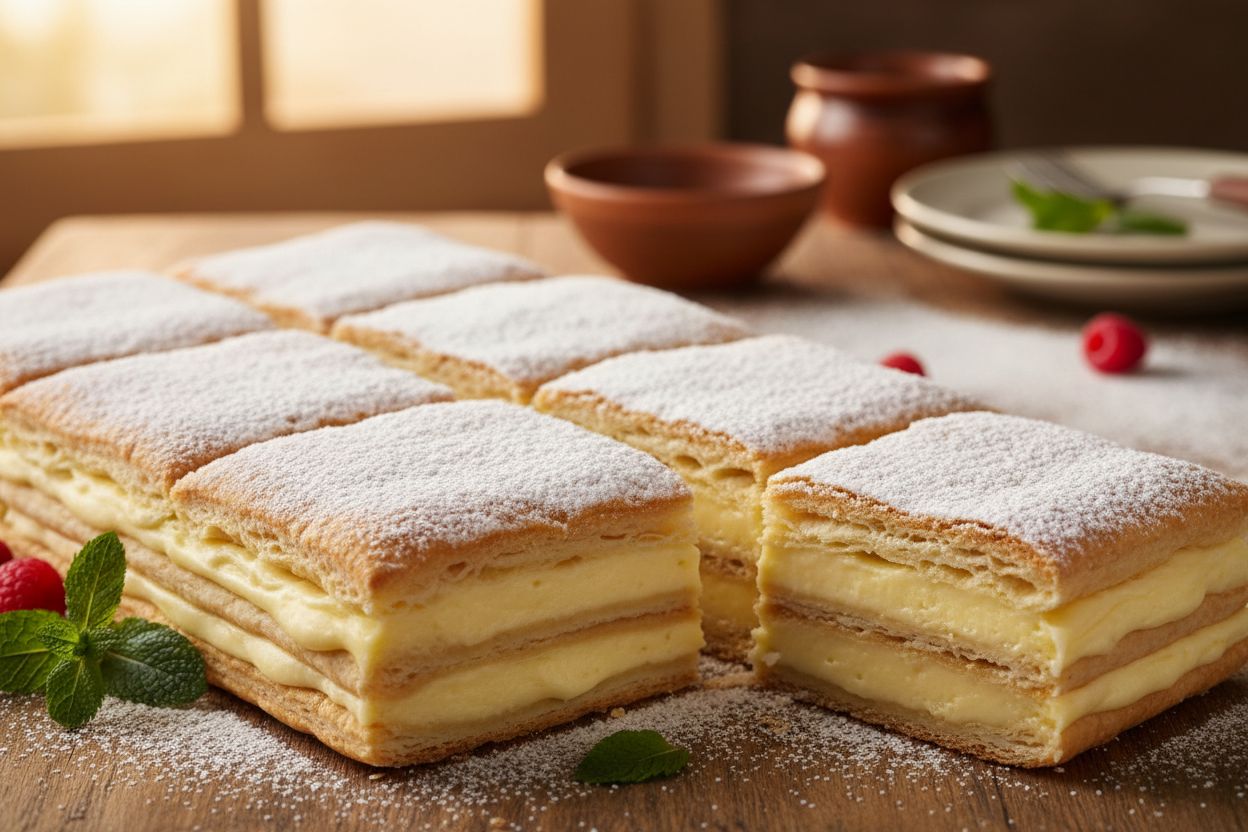



Kremówka
Background and origins
Kremówka, often called a custard slice in many bakeries, is a beloved Polish patisserie classic built on crisp, flaky layers and a billowy, vanilla-scented filling. It is traditionally finished with a veil of powdered sugar, and its contrast of textures—shatteringly light top and bottom with a lush, pudding-like center—makes each bite feel celebratory yet comfortingly familiar. The dessert blossomed in Central European pastry culture alongside other layered confections; over time, local bakers refined the formula into something airy and elegant, emphasizing delicate lamination and a silky custard with true depth of flavor. Today, Kremówka remains a café staple and a special-occasion favorite, prized for a refined simplicity that lets technique and balance shine.
Ingredients
- puff pastry (2 sheets, about 25 x 25 cm each)
- all-purpose flour (for dusting)
- whole milk (750 ml)
- granulated sugar (150 g), divided
- egg yolks (6 large)
- cornstarch (60 g)
- vanilla bean (1, split and scraped)
- unsalted butter (40 g), room temperature
- salt (pinch)
- heavy cream (300 ml), well-chilled
- gelatin (1½ tsp powdered), optional
- water (3 tbsp, for blooming optional gelatin)
- powdered sugar (for dusting the top)
Equipment
- Two baking sheets and parchment paper
- Fork or docking tool
- Rolling pin
- Large saucepan and heatproof whisk
- Mixing bowls
- Hand mixer or stand mixer with whisk attachment
- 8–9 inch (20–23 cm) square pan or similar
- Fine-mesh sieve
- Offset spatula
- Serrated or sharp pastry knife
Preparation overview
You will bake the layers of puff pastry until deeply golden, cook a vanilla custard, optionally stabilize it with gelatin, lighten it with whipped heavy cream, then assemble and chill before cutting. A final snow of powdered sugar delivers the signature finish.
Step-by-step instructions
Bake the pastry layers
Preheat the oven to 200°C. Lightly dust a work surface with all-purpose flour. Roll one sheet of puff pastry to fit your pan, keeping it even and square. Transfer to a parchment-lined baking sheet and dock thoroughly with a fork to minimize excessive lift. Lay another sheet of parchment on top and set a second baking sheet over it as a weight to encourage an even, flat bake. Bake until deep golden and crisp, about 20–25 minutes. Cool completely on a rack. Repeat with the second sheet of puff pastry. Once cool, trim both sheets to the same neat dimensions; carefully cut one baked sheet into squares (these will form clean top portions once assembled) and keep the other sheet whole for the base.
Cook the vanilla custard
In a saucepan, combine whole milk, the seeds and pod of the vanilla bean, and half of the granulated sugar. Heat over medium until steaming and just shy of a simmer, stirring to dissolve the granulated sugar. Meanwhile, in a bowl whisk the egg yolks with the remaining granulated sugar until thick and lighter in color, then whisk in the cornstarch until smooth. Remove the vanilla bean pod from the hot whole milk. Temper the yolk mixture by slowly streaming in the hot whole milk while whisking constantly. Return everything to the saucepan and cook over medium heat, whisking without pause, until the custard thickens, turns glossy, and releases a few slow bubbles. Remove from heat and immediately whisk in the unsalted butter and salt until fully melted and silky.
If you prefer added slice stability, bloom the gelatin in the measured water until spongy, then warm gently to fully dissolve (avoid boiling). Whisk the melted gelatin into the hot custard until homogenous.
Pass the custard through a fine-mesh sieve into a shallow dish to remove any tiny lumps. Press plastic wrap directly onto the surface to prevent a skin and let it stand until it reaches room temperature, then refrigerate until thoroughly cold.
Whip and lighten
Using a chilled bowl and beaters, whip the heavy cream to soft peaks. Briefly whisk the cold custard to loosen it, then gently fold the whipped heavy cream into the custard in two to three additions until smooth and airy, taking care not to deflate.
Assemble the Kremówka
Line your pan with parchment, letting excess hang over the sides for easy removal. Place the uncut, trimmed sheet of baked puff pastry in the bottom. Spread the custard filling evenly over the base with an offset spatula, smoothing the top. Arrange the pre-cut baked puff pastry squares over the filling to form the neat top pattern. Refrigerate until the filling is fully set, about 4 hours.
Finish and serve
Just before serving, lift the Kremówka from the pan using the parchment overhang. Dust generously with powdered sugar. Use a sharp serrated knife to slice cleanly, following the pre-cut top pattern so each square has a crisp lid and an intact, creamy center.
Why this method works
Weighting the puff pastry promotes even browning and a flatter profile that supports tidy layers. Cooking the custard fully after tempering activates the thickening power of the cornstarch, while finishing with unsalted butter and a touch of salt enhances flavor and silkiness. Optional gelatin lends extra slice stability, and folding in whipped heavy cream adds lightness without sacrificing structure. A final snow of powdered sugar delivers the classic look.
Tips and variations
- For the cleanest cuts, chill thoroughly and wipe the knife between slices; dust with powdered sugar right before serving to keep the top pristine.
- Stability tweak: Use the optional gelatin if you plan to transport the dessert or serve outdoors in warm conditions.
- Flavor detail: Infuse the hot whole milk longer with the scraped vanilla bean for deeper aroma; just keep it below a simmer.
- Texture cue: If your custard seems too thick before folding in the whipped heavy cream, whisk in a splash of additional chilled whole milk to loosen slightly.
- Topping: A light sifting of extra powdered sugar is traditional; avoid glazes that can soften the top layer of puff pastry.
Serving and storage
Serve Kremówka well-chilled with a final flourish of powdered sugar. Pair it with coffee or tea to complement the custard’s vanilla notes. Store leftovers covered in the refrigerator; the top will remain crispest on the first day, though the flavor stays lovely for up to two days. If the surface absorbs the initial dusting, add a very light fresh veil of powdered sugar just before presenting again.