
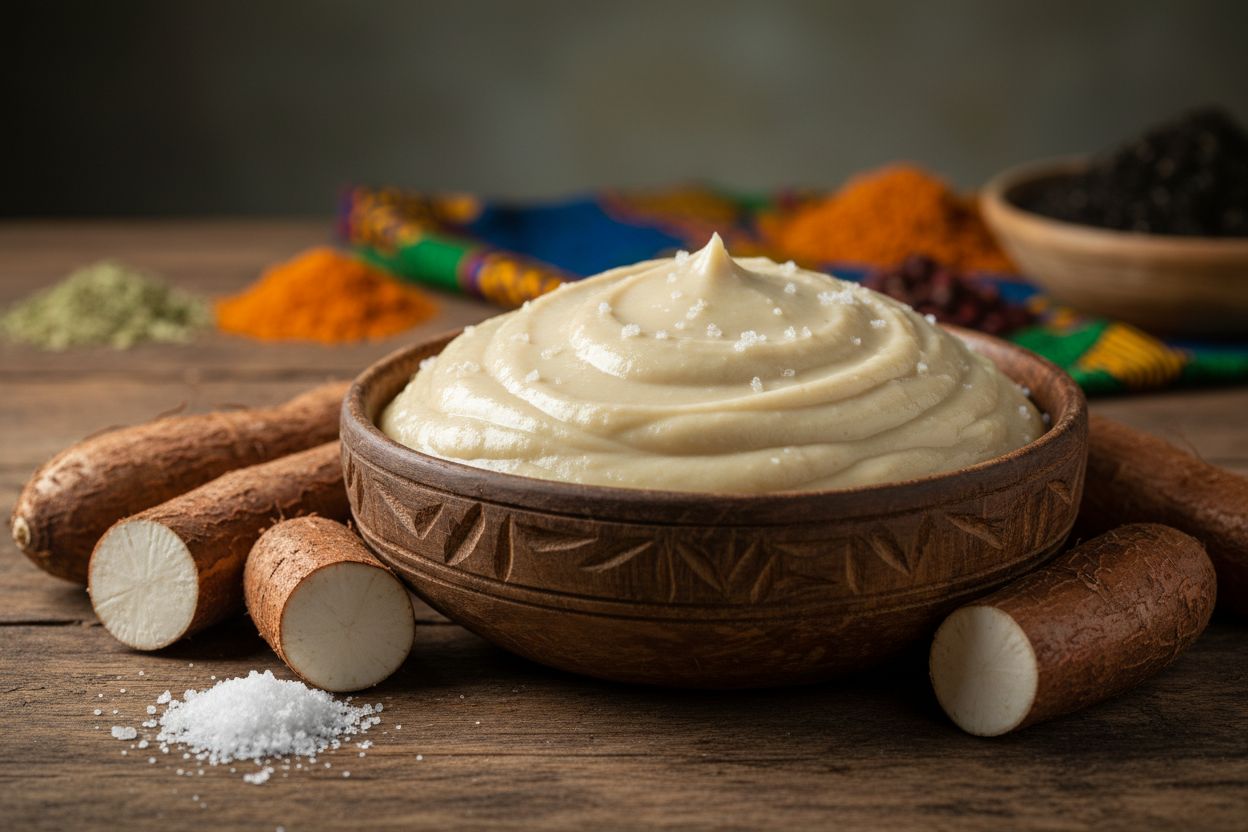



Placali
Overview
Placali is a smooth, stretchy staple from Côte d’Ivoire made by cooking a fermented paste derived from grated cassava. In many southern Ivorian households, it anchors daily meals and pairs beautifully with robust sauces. The dish highlights the gentle tang of long fermentation and the satisfying elasticity that comes from starch development. Below is a straightforward, home-cook method that preserves tradition while ensuring consistent results on a modern stovetop.
Ingredients
- cassava (peeled and fermented into a smooth paste)
- water
- Pinch of salt (optional)
Before you begin
Start with a clean workstation, a sturdy saucepan with a thick base, a wooden paddle or firm spatula, and a bowl for resting the dough. Fermentation develops the light acidity that defines Placali; if using fresh cassava, allow it to sour naturally after grating and draining, or purchase ready-to-cook fermented dough from a trusted market.
Preparation: fermentation at home
- Peel and wash the cassava, then grate it finely. Place the pulp in a cloth-lined sieve and press to remove excess liquid. Reserve a little of the starch sediment from the pressed liquid if desired; it can enrich texture later.
- Pack the grated cassava into a nonreactive container, cover loosely, and let it sour at cool room conditions until it smells pleasantly tangy. Rinse briefly to moderate acidity, then squeeze very well to obtain a compact, moist paste free of large fibers.
- Knead the paste until smooth, adding small splashes of water only as needed to help it come together. The starting consistency should resemble thick modeling clay.
- If you prefer a lightly seasoned base, work in a pinch of salt now.
Cooking process
- In a medium saucepan, stir a portion of the fermented paste with cool water to form a slurry that flows but still coats a spoon. Start with roughly equal parts by volume; you can adjust fluidity during cooking.
- Set the pan over medium heat and stir constantly with a firm spatula. As the mixture warms, it will thicken; keep scraping the bottom and sides to prevent sticking. Expect the transition from thin to thick to happen quickly around the first gentle bubbles; the active stirring period typically lasts about 10–15 minutes, depending on batch size and heat.
- Once the mixture becomes glossy and elastic, beat vigorously to develop stretch. If it seems too stiff, sprinkle in a spoonful of hot water and work it in until the paste pulls together without dry lumps; if too loose, cook a little longer while stirring.
- Taste and adjust with a tiny pinch of salt if you used none earlier. When the mass forms a smooth, shiny ball that cleanly leaves the sides of the pan, it is ready.
- Wet a bowl lightly with water, scoop in the hot dough, and smooth the surface with a moistened spatula. Allow it to settle briefly before portioning.
How to serve
Serve Placali as generous scoops beside a rich sauce such as palm nut soup, peanut stew, or okra-based gravies. Diners typically pinch off a small piece, press a shallow well in it, and use it to scoop the sauce.
Chef tips
- Texture control: For extra elasticity, beat vigorously after thickening; to soften, work in small additions of hot water during the final beating.
- Flavor balance: If fermentation runs strong, knead in a brief rinse with cool water and drain thoroughly before cooking to temper acidity.
- Batch planning: Cook smaller amounts more frequently to enjoy optimal texture; reheated portions are acceptable but slightly less springy.
- Serving temperature: Warm is best; if holding, keep covered so surface does not dry. To refresh, steam or microwave with a light splash of water, then beat briefly.
Storage and reheating
Cool completely, then refrigerate in a sealed container for up to a couple of days. To reheat, steam covered or microwave short bursts, adding a teaspoon of water if needed and stirring to restore smoothness. Avoid scorching by using low to moderate power.
Troubleshooting
- Too thin: Cook longer while stirring; the starch needs more heat to set. If very loose, dissolve a small pinch of the reserved starch sediment in hot water, then beat it in.
- Lumpy: Smash visible lumps against the pan and incorporate with vigorous strokes; if needed, strain a portion through a sturdy sieve and whisk back in with hot water.
- Too sour: Briefly rinse the paste with cool water, squeeze thoroughly, and proceed; pairing with a sweeter sauce also balances tang.
- Sticky on hands: Lightly wet fingers with clean water before shaping portions.
Notes on tradition
Placali’s roots trace to communities that cultivate cassava as a resilient staple. Fermentation was historically both a preservation step and a means to reduce natural bitterness in the tuber, yielding a food that stores well and complements the region’s soups and stews. Regional names and techniques vary, but the core principle remains: transform cassava into a tangy dough and cook it into a supple base for communal meals.