
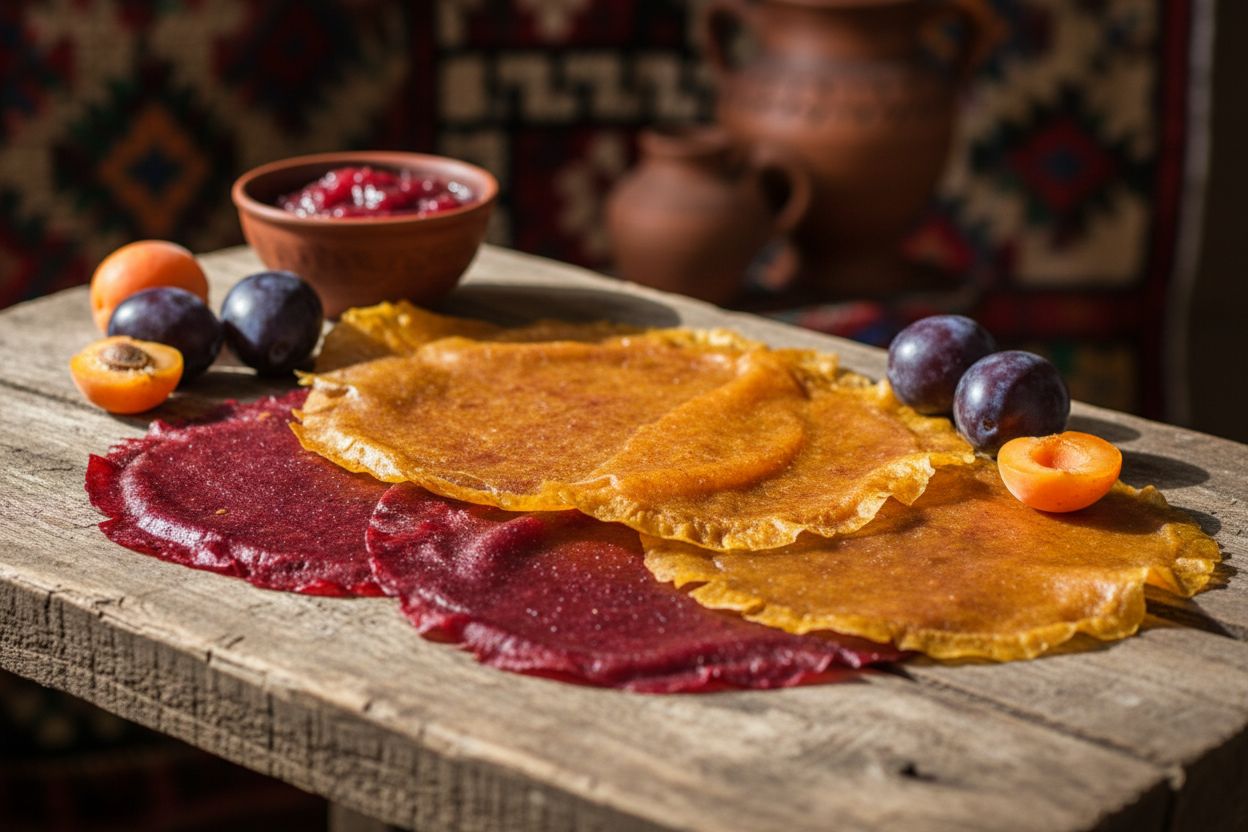



Tklapi
Tklapi is a classic Georgian fruit leather made by cooking and drying a smooth puree of plums or apricots until it transforms into a thin, flexible sheet. Families have long prepared it to preserve the seasonal bounty, often using sour wild varieties of plums for a tangy, savory base or golden apricots for a naturally sweet finish. In village kitchens, the puree is spread on boards or trays and dried in the sun, then rolled or folded for storage and for use in everyday cooking, travel snacks, and festive tables. A sour sheet made from tart plums can be torn and stirred into soups or stews as a brightener, while a sweet sheet made from ripe apricots serves as a tender, chewy confection. Today you can make Tklapi at home in an oven, a dehydrator, or even on a warm balcony with a screen, and the technique remains simple and adaptable.
Ingredients
- 2 kilograms ripe plums or ripe apricots, pitted
- sugar to taste, optional
- Juice of 1 lemon
- About 120 milliliters water, as needed
- Pinch of salt for a savory version, optional
Preparation
- Sort and prep the fruit. Choose fragrant, ripe plums or apricots. Wash well, then halve and remove pits. If using very tart plums, keep skins for color and depth of flavor. Toss the fruit with the juice of the lemon to preserve color.
- Cook the fruit gently. Place the prepared plums or apricots in a wide, heavy pot with a splash of water. Add a small amount of sugar if making a sweeter sheet, or a tiny pinch of salt if you prefer a savory, tart sheet. Set over low heat and cook, stirring often, until the fruit softens completely and releases its juices.
- Puree and strain. Use an immersion blender to puree the mixture until smooth. For a silkier sheet, pass the puree through a fine sieve to remove skins and fibers. Return the puree to the pot. Taste and adjust with a touch more sugar for sweetness, a few drops of lemon for brightness, or a whisper of salt if leaning savory.
- Reduce to the right consistency. Simmer the puree over low heat, stirring regularly to prevent scorching, until thick but still pourable. The puree should coat the back of a spoon and leave a clean line when you drag a finger across it. If it gets too thick, loosen with a spoonful of water.
- Prepare trays. Line rimmed baking sheets or dehydrator trays with silicone mats or parchment. Lightly oil if using parchment to prevent sticking, then pour on the puree. Spread evenly with an offset spatula to a uniform thin layer, roughly 2 to 3 millimeters thick, leaving a small border around edges to reduce over-drying.
Cooking and drying
Choose one drying method and monitor the sheet as it transforms from glossy puree to a soft, flexible leather. Rotate trays as needed and watch the edges, which tend to dry first.
Oven method
- Set the oven to its lowest setting. Place the trays on the middle racks and prop the door slightly ajar to allow moisture to escape. Dry until the surface is no longer sticky and the sheet peels cleanly from the liner, typically about 3 to 6 hours depending on thickness and oven temperature. If the center is still tacky when the edges are done, trim off the dry edges and return the tray to finish.
Dehydrator or sun method
- Dehydrator: Arrange trays per your model and dry on a low fruit-leather setting. Sun: Place trays in a protected, breezy spot with a mesh cover to keep insects off. Dry until supple and peelable, often around 6 to 12 hours, varying with humidity and airflow.
Finishing and storage
- Peel and cut. Once dry and flexible, lift a corner and peel the sheet from the liner. Use scissors to cut into rectangles or long strips. For rolls, place the sheet on fresh parchment, roll tightly, and slice into portions.
- Store properly. Cool completely, then wrap the pieces or rolls in parchment and keep in an airtight container. Store in a cool, dark cupboard. For very long storage in warm climates, refrigerate or freeze well-wrapped pieces.
How to enjoy
- Snack straight from the roll. Sweet versions made from ripe apricots and a touch of sugar are chewy, bright, and naturally fragrant.
- Balance savory dishes. Tear a little of a tart sheet made from sour plums and a whisper of salt into soups, stews, or braises to add gentle acidity.
- Pair with cheese and tea. Serve strips alongside soft cheeses or with a cup of black tea for a simple Georgian-inspired snack.
- Use as a wrap. Cut rectangles and wrap around soft cheese or creamy desserts for contrast.
Tips and variations
- Fruit choice: Tart plums yield a classic sour profile ideal for savory cooking; golden apricots create a naturally sweet, perfumed sheet for snacking.
- Flavor balance: Start with very little sugar and adjust slowly. A few drops of lemon can sharpen flavors. For a savory pantry staple, include just a pinch of salt.
- Consistency matters: If the puree is too thin, it will take much longer to dry and may crack unevenly; cook it down briefly and, if needed, add a teaspoon of sugar or a squeeze of lemon to round the taste. If too thick, whisk in a splash of water until it spreads smoothly.
- Even layers: Keeping the layer uniform helps prevent brittle edges. If edges dry too fast, brush them with a little water to rehydrate while the center finishes.
- Color retention: The acidity of lemon helps keep bright color, especially with red plums and golden apricots.
Troubleshooting
- Too sticky: Dry longer and be patient. If the oven is too warm, reduce the heat and extend the time; check every so often near the end of the range noted above of 3 to 6 hours and 6 to 12 hours.
- Too brittle: The layer was either too thin or overdried. Next time, spread slightly thicker and consider brushing edges with water midway.
- Dull flavor: Add a touch more lemon and balance with a teaspoon of sugar or a tiny pinch of salt depending on your target style.
Make it your own
Begin with the basic formula of cooked puree and gentle drying, then decide whether you want a sweet snack or a savory pantry staple. For bright, tangy cooking sheets, lean into sour plums and a whisper of salt. For dessert-friendly rolls, choose ripe apricots, accent with a squeeze of lemon, and, if desired, a spoon of sugar. Keep the puree smooth, the layer even, and the finish flexible, and you will have Tklapi that captures peak-season fruit in a form that keeps beautifully and fits countless meals and moments.