
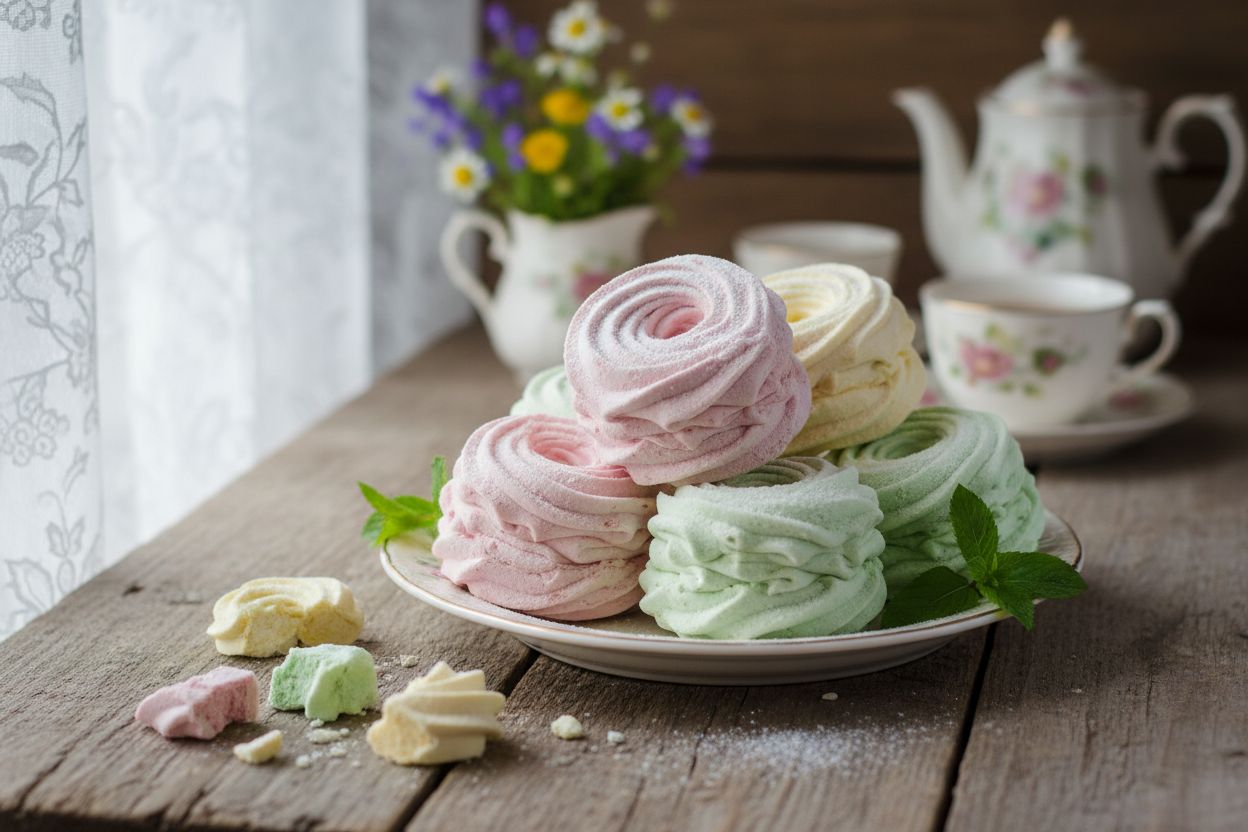



Zefir
Zefir is a pillowy, fruit-forward confection from Eastern Europe, named after the gentle west wind of mythology to evoke its light texture. It sits at the intersection of marshmallow, meringue, and pate de fruit, yet it is distinctly its own: tender, buoyant, and softly tangy from fruit. Classically piped into elegant swirls and paired into sandwich-like domes, it was popularized in the 20th century as a showcase of confectionery craft. The signature texture comes from whipping a fruit base into a lofty foam and stabilizing it with a plant-derived gelling system, then letting it dry into a delicate shell with a tender interior.
Ingredients
- 250 g apple puree, unsweetened and smooth
- 300 g sugar, divided (250 g for syrup, 50 g for whipping)
- 2 large egg whites, room temperature
- 8 g agar agar powder
- 150 g water
- 1 tsp vanilla extract
- 1 tsp lemon juice
- 2 tbsp powdered sugar, for dusting
Equipment
- Stand mixer or hand mixer with whisk attachment
- Heavy-bottomed saucepan and candy thermometer
- Piping bag with large closed star tip
- Silicone mats or parchment-lined sheet trays
- Spatula and heatproof jug for pouring
Preparation
- Pan and piping prep: Line two sheet trays with silicone mats or parchment. Fit a piping bag with a large closed star tip and stand it in a tall glass so it’s ready to fill. This ensures you can pipe promptly once the mixture reaches the ideal texture.
- Bloom the gelling base: In a small saucepan, combine 8 g agar agar with 150 g water. Stir to hydrate thoroughly, then let it sit for about 10 minutes to bloom. Proper blooming ensures the agar agar dissolves evenly and sets with a clean, delicate bite.
- Cook the syrup: Place the bloomed agar agar mixture over medium heat and bring it just to a simmer, stirring. Add 250 g sugar and cook, stirring at first to dissolve. Then stop stirring and continue to cook the syrup until it reaches 110–112°C (soft-ball stage), usually about 6–8 minutes, depending on your burner and pan. Keep the syrup at a gentle but steady boil so the temperature climbs evenly.
- Whip the fruit base: While the syrup cooks, add 250 g apple puree to the bowl of a stand mixer. Sprinkle in 50 g sugar and whisk on medium speed until slightly lightened, about 2–3 minutes. Add 2 large egg whites and increase to medium-high, whipping to a stable, glossy foam with firm peaks, about 4–6 minutes. Whisk in 1 tsp vanilla extract and 1 tsp lemon juice just to combine, about 30 seconds.
- Stream in the hot syrup: With the mixer running on medium speed, carefully and steadily pour the hot syrup (110–112°C) down the side of the bowl into the whipping foam. Avoid the whisk to prevent splatter. Once all the syrup is in, continue whipping until the mixture thickens, turns glossy, and the ribbons settle slowly on the surface, typically 2–3 minutes. The mass should be warm but pipeable and hold defined ridges.
- Pipe the swirls: Transfer the mixture to the prepared piping bag. Pipe uniform rosettes onto the lined trays, holding the bag vertically and applying even pressure for crisp ridges. Work efficiently; as the mass cools, it will set.
- Set and dry: Let the piped shapes stand at room temperature until the outsides form a delicate, non-sticky shell and the centers are tender yet stable, typically 4–6 hours depending on ambient humidity. Good airflow helps achieve a fine crust without over-drying.
- Finish: Gently lift the pieces, pair similar sizes into sandwiches, and dust lightly with powdered sugar to prevent sticking and to accentuate the sculpted ridges.
Why this method works
The airy foam is created by vigorous whipping, which stretches and stabilizes bubbles into a fine network. Introducing a hot, concentrated syrup that contains a plant-based gelling agent strengthens that network and helps it set with a tender, elastic crumb. Piping while the mixture is still warm captures the optimal viscosity, so the ridges are pronounced and the interior remains feather-light after the set.
Make-ahead, storage, and serving
- Make-ahead: Pipe and set the same day. Once dry to the touch, pair and dust, then store in an airtight container.
- Storage: Keep at cool room temperature, layered between parchment if needed, for up to 3–4 days. Avoid humidity, which softens the shell.
- Serving: Present with tea or coffee, or as a light dessert after a rich meal. The contrast of the delicate shell and tender interior is best within the first two days.
- Gifting: Pack in snug boxes so pieces don’t jostle. A light veil of powdered sugar keeps them pristine.
Troubleshooting and tips
- If the mixture sets too quickly in the bowl, your syrup may have been slightly overcooked or the ambient temperature was low. Pipe faster, or keep the bowl slightly warm to extend the working window.
- If the piped ridges slump, the foam wasn’t fully structured. Next time, whip a bit longer before adding the syrup, or continue whisking a little more after streaming the syrup until ribbons hold.
- If the exterior stays tacky for too long, increase airflow in the room or extend the resting period by 30–60 minutes as needed.
- For cleaner separation from parchment, lift gently and twist slightly. If sticking persists, dust the surface lightly with powdered sugar and let it rest for another 15 minutes before trying again.
Flavor variations
- Fruit profile: Swap part of the 250 g apple puree with another smooth, tart fruit base of similar consistency to adjust aroma and tang. Keep the overall solids and acidity balanced so the foam sets properly.
- Citrus accent: Increase the 1 tsp lemon juice slightly for a brighter finish, especially if your fruit base is mellow.
- Vanilla nuance: Use a fragrant 1 tsp vanilla extract to enhance the confection’s creamy aroma without obscuring the fruit.